How Many Milk Crates Do I Need? A Simple Guide
Not sure how many milk crates to buy? Learn how to estimate the right number for vinyl records, books, shoes, moving, and more - or use our free calculator.
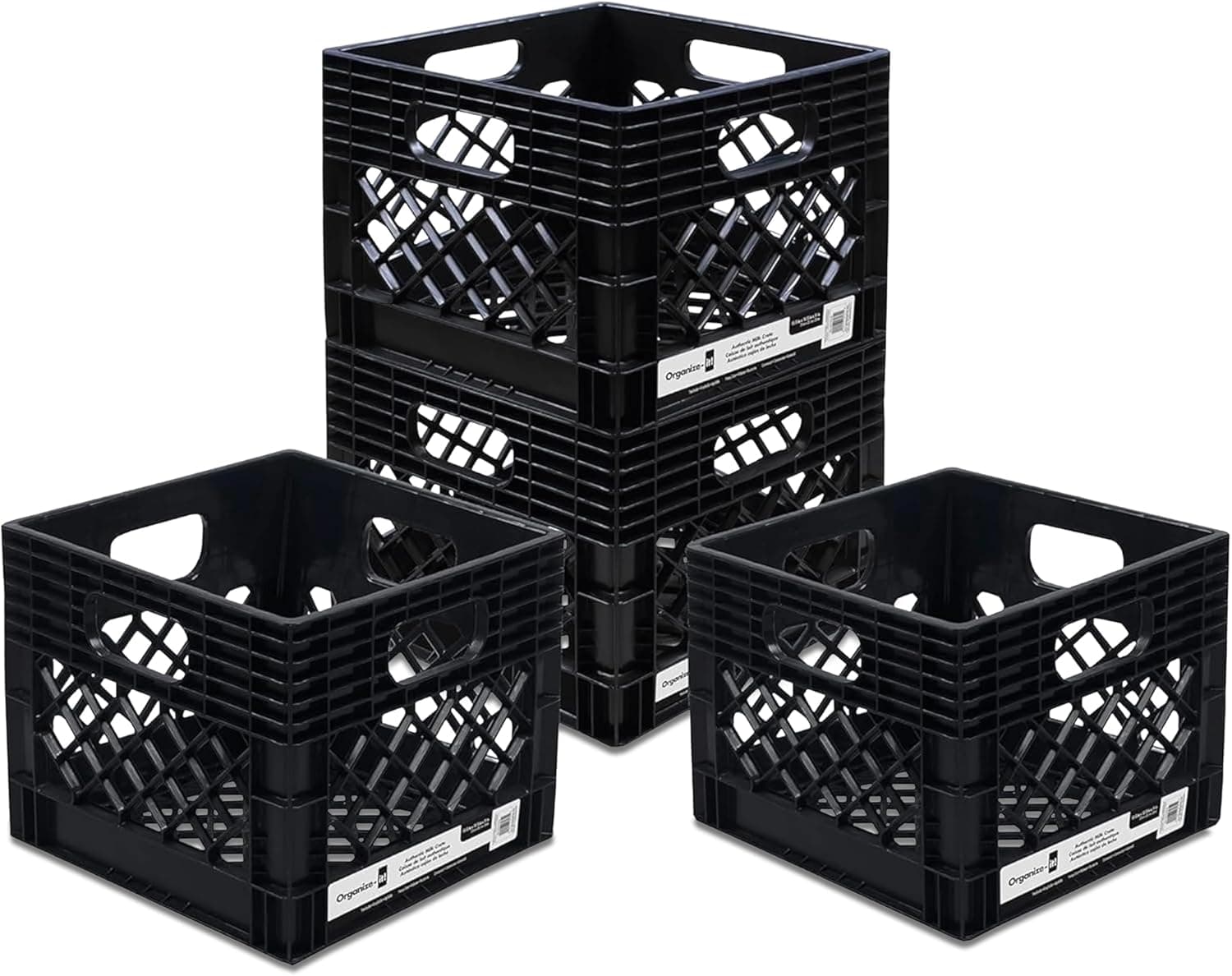
Buying too few milk crates means a second trip to the store. Buying too many means wasted money and a pile of crates you don't need. Getting the number right before you buy saves both.
This guide walks you through estimating crate counts for the most common use cases. If you want a precise answer in under 30 seconds, jump straight to our milk crate calculator - pick what you're storing and it does the math for you.
The Quick Formula
Every estimate comes down to the same basic idea:
Number of crates = Total items ÷ Items that fit per crate
The tricky part is the denominator. How many items actually fit per crate depends on:
- Crate size - square 16QT (13" × 13" × 11") vs. rectangular 24QT (19" × 13" × 11")
- Item dimensions - flat objects pack tighter than irregular ones
- How you pack - upright vs. flat, loose vs. tight
The sections below give you real-world numbers for the most popular use cases.
Vinyl Records
Vinyl is the classic milk crate use case, and the square 16QT was practically designed for it - a 12-inch LP sleeve is 12.4 inches square, which slots in perfectly.
| Crate Type | Records That Fit |
|---|---|
| Square 16QT (13" × 13" × 11") | ~65 LPs |
| Rectangular 24QT (19" × 13" × 11") | ~100 LPs |
Examples:
- 100 records → 2 square crates (65 + 35)
- 200 records → 4 square crates
- 500 records → 8 square crates
These numbers assume upright storage with enough slack to flip through records comfortably. Packing them in tight can squeeze out a few more, but that puts stress on the sleeves.
For 7-inch singles, figure about 220 per square crate. For mixed collections (LPs and 7-inches), count them separately and add the crate totals together.
Books
Books vary more than records because spine width differs so much between paperbacks and hardcovers. These numbers assume books stored upright:
| Book Type | Per Square 16QT | Per Rectangular 24QT |
|---|---|---|
| Paperbacks (average 1" spine) | ~40 | ~60 |
| Hardcovers (average 1.5" spine) | ~25 | ~40 |
Examples:
- 80 paperbacks → 2 square crates
- 50 hardcovers → 2 square crates
- Mixed 100 (half/half) → 3 square crates
For large-format art books or textbooks, treat them individually - measure the width, divide the interior crate width (about 12.25 inches) by that number, and multiply by how many rows fit in the height.
Shoes
A standard men's shoe box is roughly 13" × 7.5" × 5". The fit depends a lot on orientation:
| Crate Type | Shoe Boxes That Fit |
|---|---|
| Square 16QT (13" × 13" × 11") | ~2 boxes flat, 2 layers = 4 total |
| Rectangular 24QT (19" × 13" × 11") | ~6 boxes flat |
Most people store shoes without boxes, which packs more efficiently:
- Without boxes, a square crate holds roughly 4–6 pairs of shoes depending on size
- A rectangular crate holds around 8–10 pairs
Examples:
- 20 pairs of shoes → 4–5 square crates (or 2–3 rectangular)
- A family of 4 with 10 pairs each → 8–10 square crates
Moving & General Household Items
For a move, milk crates are great for kitchen items, bathroom products, books, and anything that benefits from a sturdy stackable box. They're less ideal for bulky soft items like pillows or linens.
A rough rule of thumb for household packing:
| Room | Square Crates Needed |
|---|---|
| Kitchen (dishes, pantry items) | 6–10 |
| Home office / books | 4–8 |
| Bathroom | 2–4 |
| Bedroom (clothes, accessories) | 3–6 |
| Full 1-bedroom apartment | 15–25 |
| Full 2-bedroom house | 25–45 |
These are ballpark figures. Minimalists need fewer; collectors need more.
Tools & Hardware
For a garage or workshop, the rectangular 24QT is usually the better choice - deeper tools and power tool accessories fit better in the wider footprint.
- Small hand tools (hammers, screwdrivers, pliers): 1 crate per 15–20 tools
- Hardware bins (nuts, bolts, screws in small containers): 1 crate per 20–30 containers
- Power tool accessories: estimate by volume - a 24QT crate holds about 1.5 cubic feet
How to Estimate Custom Items
For anything not on this list:
- Measure your item: length × width × height in inches
- Get the crate's interior dimensions (subtract 0.75" from each exterior dimension)
- Figure out how many items fit per layer: (crate length ÷ item length) × (crate width ÷ item width), rounded down
- Figure out how many layers: crate height ÷ item height, rounded down
- Multiply: items per layer × layers = items per crate
- Divide your total items by items per crate, round up
This gets tedious fast, especially when you want to compare across multiple crate types. The milk crate calculator handles all six packing orientations automatically and shows you which crate gives the best fit for your specific item.
A Note on Rounding Up
Always round up to the next whole crate - you can't use half a crate. Also add one buffer crate if:
- Items are irregular in shape (they won't pack as efficiently as the math suggests)
- You plan to add more items over time
- You need lids, and lids require the crates not to be completely full
The Easiest Way: Use the Calculator
If you've got a specific item or situation in mind, the fastest path is the milk crate calculator. Pick your use case (vinyl, books, shoes, tools, moving boxes) or enter a custom object size, enter your quantity, and it instantly shows you how many crates you need - broken down by all four standard crate types so you can pick the one that works best.
It also links directly to the best-reviewed options in each size, so you can go from "how many" to "order placed" in one stop.